
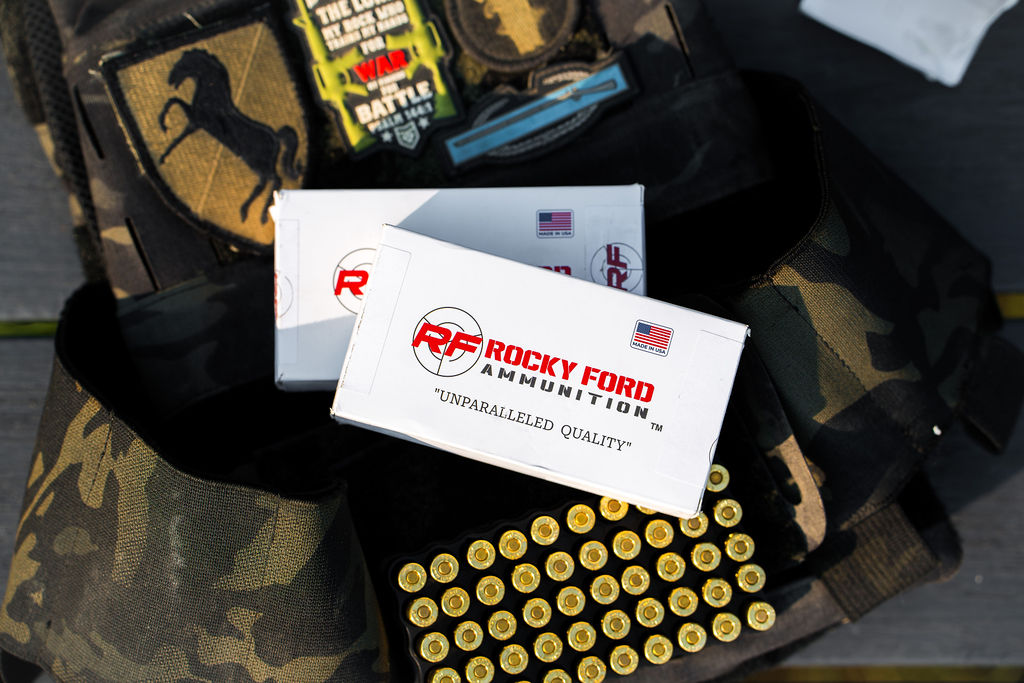
Rocky Ford sent me the ammunition for this review. They asked for one thing in return: an honest write-up. That’s the only kind I know how to do, so let’s get into it.
Rocky Ford is an ammunition brand no one has really heard of in the competition scene. I came across them because of a YouTube video where David, the President and Owner of Rocky Ford, was discussing grain weights. He goes down the rabbit hole and gives great insight into the different grain weights and what they do. From that one video I could tell he had the passion and the knowledge base to make some great ammunition. I reached out, and that is how this review started.
Fast forward to the end of the competition season and 2,500 rounds of .223 and 9mm later. How did the ammunition hold up compared to the big-name brands? Could a small Mississippi ammo company actually hang with them when it matters? Read on to find out.

Who Is Rocky Ford Ammunition?
Rocky Ford is a veteran-owned American ammunition manufacturer based in Mississippi. They are focused on delivering premium-quality ammunition for competitive shooters, tactical athletes, and serious firearms enthusiasts.
They pride themselves on consistent, reliable ammunition. That comes from meticulous loading practices, quality components, and real-world performance testing. The goal is ammunition engineered for consistency and confidence.

Why Ammunition Choice Matters in Competition
Ammunition choice is extremely important in competition shooting because it directly impacts accuracy, recoil control, and reliability. As competition shooters, we want to minimize standard deviation (SD) between rounds. Standard deviation is the variation in muzzle velocity from one round to the next. The smaller it is, the more you know what to expect when shooting at distance. Consistent velocity also means a consistent recoil impulse, which allows for faster follow-up shots on the clock. Finally, consistent loads give you accurate ballistic data for your holdovers at longer distances.
One bad round on the clock costs you a stage. In The Tactical Games, a malfunction while your heart rate is redlined costs you far more than time.
Ammunition choice reminds me of Ecclesiastes 10:10:
10 If the iron be blunt, and he do not whet the edge, then must he put to more strength: but wisdom is profitable to direct.
If you don’t sharpen the iron to a fine edge, you have to put more strength into the work. The same goes for ammunition. If you don’t have the right ammunition for the job, you are putting in a lot more effort to get the same result.

Nerd Stuff: The Loads I Ran
If you have been following the blog, you know I mainly shoot The Tactical Games. The Tac Games borrows from other shooting sports, so in one weekend you can go from knocking down heavy steel to shooting at distance. With those variables in play, you need to pick your grain weights carefully.
I went with the 147-grain for 9mm because it has enough mass to knock down steel but still lets me shoot accurately out to 25 to 50 yards. For .223, I shot 62-grain last year because my rifle handled it perfectly, so I went the same route this year with Rocky Ford’s 62-grain load.
For velocity testing I ran a Garmin Xero C1 Pro chronograph and shot 20-round strings to get an accurate picture of muzzle velocity and standard deviation. I also asked David what his testing showed for each load. Here is how his numbers compare to what I got on my guns:
9mm 147-Grain
- David’s numbers: 915 FPS, SD of 11.11
- My numbers: 915 FPS, SD of 10
.223 62-Grain
- David’s numbers: 2624 FPS, SD of 18
- My numbers: 2628 FPS, SD of 18
The 9mm matched exactly and the .223 was within 4 FPS. When a small company’s numbers hold up on somebody else’s chronograph, on different guns, in a different state, that tells you the loading is consistent from batch to batch.

Rocky Ford 9mm: 1250 Rounds Through the Hulk Platy
I was excited to run the Rocky Ford 9mm 147-grain through several different types of competition: two Tactical Games Regional events, USPSA, and 2-Gun matches. After 1,250 rounds, did I have any issues?
Not one. Zero malfunctions and zero hard primers. Compensated guns are known to be picky with ammunition, and that wasn’t the case here. The Rocky Ford 147-grain runs extremely well in the Hulk Platy. The recoil impulse is very consistent, and the rounds kept the Platy shooting flatter than other brands I have run.
During the year I shot two USPSA matches to test the ammo against other brands, using the same grain weight for both. I shot more accurately with Rocky Ford and had more A-zone hits. The consistent recoil impulse kept the red dot in the window.
Shooting 2-Gun, I was curious whether the ammo had enough power to knock down steel. Rocky Ford didn’t disappoint. I had no issues with the heavier steel, and the ammo cycled the Platy without a hiccup.

Rocky Ford .223: 1250 Rounds Through My AR-15
Running a 62-grain .223 again for the 2026 season was a no-brainer after the success I had with 62-grain in 2025. I wanted to see how a more precise round would hold up in competition. My rifle is a self-built Frankengun with a 16″ Faxon Gunner barrel, and the Rocky Ford ammunition ran flawlessly in it.
I was able to hit targets from 150 to 600 yards, and I ran several long-distance training sessions with it. Every round cycled and there were no issues.

Power Factor: Making Minor Without the Snap
The Rocky Ford 9mm 147-grain has a Power Factor of 134.5. USPSA requires a minimum of 125 for minor, so that is a 9.5 margin. It’s a nice buffer if USPSA chronos your rounds on a cold day, and it’s still soft enough to shoot fast. That’s the tradeoff you want.

Consistency: Velocity Spread and Accuracy
I ran a ton of strings through the Garmin because I wanted to see how the standard deviation held across all the rounds, not just one box. The numbers stayed right where they were in the Nerd Stuff section: SD of 10 on the 9mm and SD of 18 on the .223.
What do those numbers mean? A smaller SD means the gun behaves the same way shot to shot. You are taking out another variable that could cost you a podium finish or a target. The fewer variables you have to deal with, the better.
So how does Rocky Ford compare to other brands? I tested Freedom Munitions, Federal Champion, and American Eagle the same way and ended up with a broad range of velocities and standard deviations:
Freedom Munitions 9mm 147-Grain
- Average velocity: 915 FPS
- SD: 25
Freedom Munitions .223 62-Grain
- Average velocity: 2700 FPS
- SD: 29
Federal Champion 9mm 147-Grain
- Average velocity: 1050 FPS
- SD: 18
American Eagle .223 62-Grain
- Average velocity: 2780 FPS
- SD: 30
Rocky Ford had the tightest SD in both calibers. Of all the ammo I have shot, Rocky Ford is hands down the most consistent I have used.

Reliability: Did I Have Any Failures?
Zero failures across both platforms. The AR-15 ran the .223 with no issues on the clock and in training, and the Hulk Platy ran the 9mm the same way. Every round went pew pew when I pulled the trigger.
I also kept an eye on the casings. If you are not familiar with why this matters, a split near the neck or mouth causes gas leakage or a failure to extract. A split or crack toward the body or case head is worse, because high-pressure gas can escape into the action of the AR-15. That can jam the rifle, damage the extractor, blow out the magazine, or damage the upper receiver. I am happy to report no cracks or splits. Every casing I looked at came out looking brand new.

Under Stress: Rocky Ford at The Tactical Games
The Tactical Games pushes your firearms harder than most shooting competitions, and it is where I really got to test Rocky Ford.
The Missouri Regional was rainy and muddy. Missouri got a ton of rain the day before, and the range was a mess. There were times I dropped magazines in the mud and didn’t clean them. Then the heat came out and we dealt with the sand. I ended up with sand and mud inside the Hulk Platy. It was avoidable, but the Platy kept running and the ammo didn’t care one bit.
At the Iowa Regional we dealt with heat, dust, and sand. As you all know, sand and dust get into everything. Iowa was extremely hot, and I stored my ammo in a metal ammo can. At one point I forgot to move the can under our tent, so it sat out in the sun, cooking. It didn’t affect the ammo at all. Rocky Ford ran smooth.
I had no issues at either Regional, which matters because these sports are won and lost by seconds. A malfunction or a hard primer that doesn’t go off costs you time, and we all know a malfunction sticks with you the rest of the weekend. You spend the next stage worrying about it happening again. Consistent, reliable ammo takes that worry off the table, and that is another way it helps you win matches.
If you are curious how those events went, check out my TTG Missouri recap and my TTG Iowa recap.

How Dirty Does It Run?
After thousands of rounds, I was surprised at how clean Rocky Ford runs. I noticed it most in the Hulk Platy. Normally the slide starts to slow down after about 500 rounds. With Rocky Ford, I could get away with more rounds between cleanings.
The AR-15 was the same story. After a Tactical Games Regional, my AR wasn’t as dirty as it normally is. That was nice during Wednesday Night Minnesota Multigun, because I didn’t have to clean either gun before the next match.
I also kept an eye on flash and smoke. I run a Sharps Bros Badlands Deflector on my AR-15, which minimizes flash on its own, so keep that in mind. Rocky Ford had about the same flash as other brands and did not smoke any more than other brands either. If you have ever shot indoors, you know why that matters.

Price and Availability vs. the Big Brands
Rocky Ford has strong pricing for hand-loaded ammunition. Their competition 9mm runs $23.00 for 50 rounds in both 124 and 147-grain, which comes out to $0.46 a round. Compare that to Federal Syntech or Federal Gold Medal Action Pistol, which sit at $0.58 to $0.71 per round. Rocky Ford is giving you premium hand-loaded ammunition at a more affordable price.
Rocky Ford is based in Mississippi, and I had ammo shipped to both South Dakota and Minnesota. Shipping was faster than most places I have ordered from. I have dealt with companies that are painfully slow, and Rocky Ford is not one of them.
Lower cost, higher return. The price isn’t high, and it is worth every penny for what you are getting.

What I’d Change
Rocky Ford was very consistent with both pistol and rifle rounds, so what would I change?
With the 9mm 147-grain, nothing. It is a solid round with great velocity for competition. At 915 FPS it might not make it through a denim jacket, but it isn’t built for that. It’s built for competition.
For the .223, I would love to see a heavier option. My 62-grain got pushed around by the wind at times, and I want to run a 69-grain next year. The .223 packaging could also use some work. The rounds come loose in the box, which isn’t a big deal on its own, but the boxes don’t hold up well. Those are the only issues I ran into.

Who Should Be Shooting Rocky Ford?
Rocky Ford is consistent, hand-loaded ammunition. They test what they load and make adjustments to meet the customer’s needs. That puts them in a different category than your bulk blaster ammo for fun range days.
Rocky Ford is for the shooter who wants consistency across large batches: the competition shooter, the hunter, the self-defense carrier, and law enforcement. It has held up in several competition settings and never let me down. It isn’t for the casual range shooter looking for the cheapest rounds to send downrange.

To Make a Long Story Short
Is Rocky Ford Ammunition worth the investment? It isn’t a crazy investment to begin with, and my answer is a thousand times yes. The cost isn’t much for very consistent hand-loaded ammunition, and that is exactly what a competitive shooter needs. You want to take out as many variables as you can, and Rocky Ford does that for you.
Rocky Ford sponsored me this season, and all they wanted in return was an honest review. So I went in trying to find things to complain about, because I want to give honest feedback when I am asked for it, and I came up nearly empty. I had a great experience with this ammo and no failures. Even if Rocky Ford doesn’t sponsor me next year, I will be buying more of it for the 2027 Tactical Games, PCSL, and 2-Gun season.
Thank you to Rocky Ford for allowing us to review and run your ammunition for the 2026 season. We are excited about a possible partnership for 2027. Now I am curious: will you be placing an order with Rocky Ford? Had you heard of them before this article? Let us know in the comments below.

Leave a Reply